Destination Profile
Uttarakhand Forest Motorcycle Tour — From Tiger Country to the Himalayan Meadows
The Experience
Uttarakhand has two faces that most riders see separately. The pilgrimage routes through Garhwal — Rishikesh, Haridwar, Kedarnath, Badrinath — draw millions of visitors and the roads there reflect it. The Kumaon hills in the east are the other face: quieter roads, denser forest, a different character entirely. This expedition connects them by a route that starts in tiger country and ends in a Himalayan meadow with a wall of 6,000-metre peaks on the horizon.
Jim Corbett National Park is India's oldest tiger reserve, established in 1936. The perimeter roads that run along its buffer zone are some of the finest forest driving in the subcontinent — the tarmac good enough to move at proper speed, the tree cover close enough on both sides that the temperature drops five degrees and the light filters. We ride the Kalagarh segment of the buffer zone rather than the more tourist-heavy Ramnagar approach. The Kalagarh road is the one that runs along the Ramganga reservoir through forest where tiger sightings from the road are not unheard of.
Binsar Wildlife Sanctuary, 100 kilometres northeast of Corbett, is an oak and rhododendron forest at 2,400 metres with a viewpoint called Zero Point where, on clear mornings between October and March, the view extends across the Himalayan main range from Kedarnath in the west to the Panchachuli peaks in the east — a continuous wall of snow at 200 kilometres' distance. The sanctuary is one of the few in India where walking is permitted on all 62 kilometres of its track network.
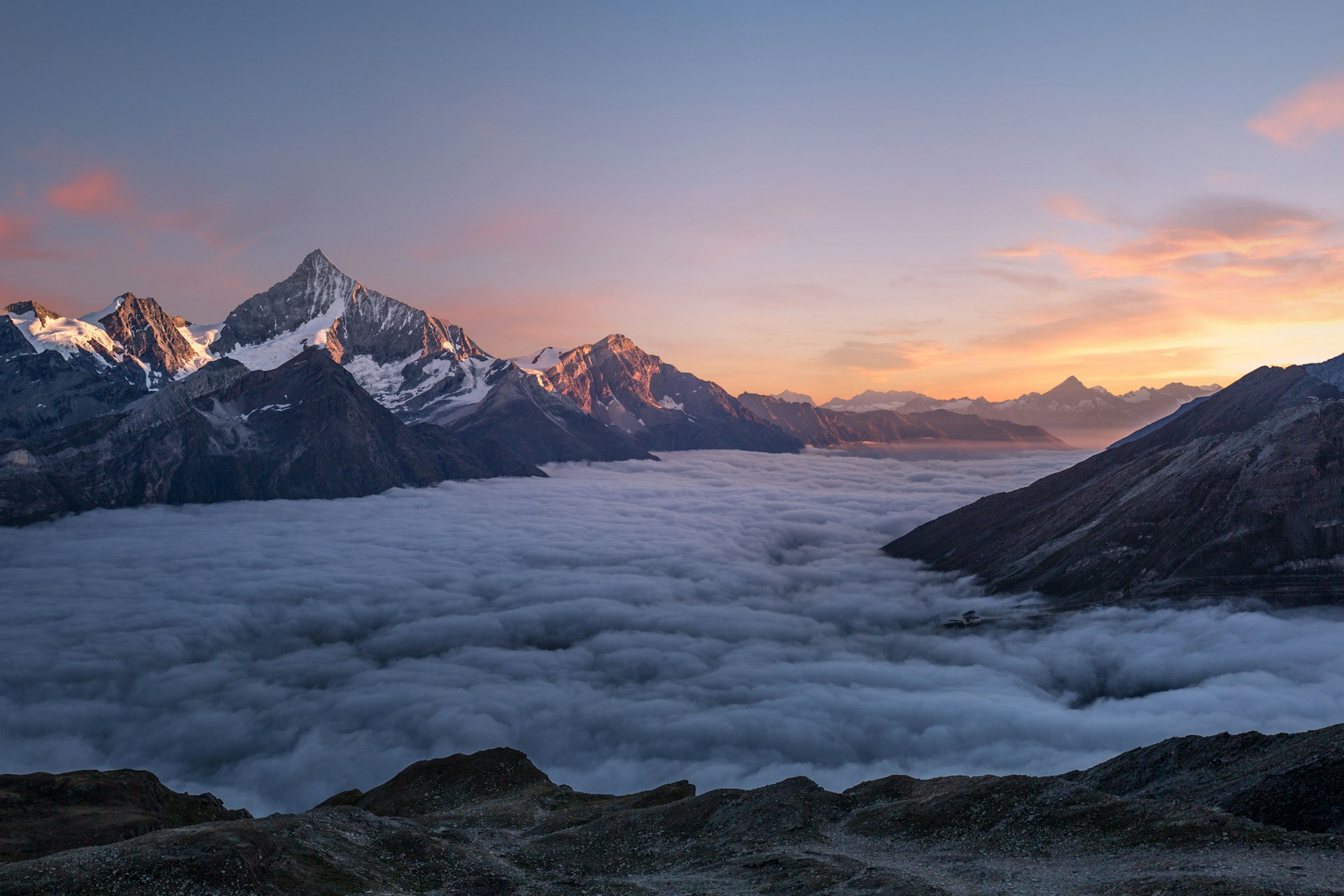
Munsiyari sits at 7,200 feet in the Johar Valley near the Tibetan border. The town itself is small — a main road, a few guesthouses, a market that supplies the villages further up the valley — but the view from it is what draws riders. Panchachuli, five separate summits between 6,900 and 7,000 metres, dominates the eastern sky. On clear mornings at dawn the peaks catch the first light and turn a specific shade of orange that lasts about four minutes. The Khaliya Top meadow above the town at 3,500 metres is reachable in two hours on foot and from it the view extends into Nepal.
The road to Munsiyari from Pithoragarh via Thal and Kalamuni Top is one of the best stretches of hill road in Kumaon. It climbs through oak and deodar forest, comes out above the treeline at Kalamuni at 2,850 metres, then drops into the Johar Valley on a series of switchbacks with the Gori Ganga river visible below. On this road, in two and a half hours of riding, you pass through four distinct ecological zones.
Why This Route?
Because Uttarakhand is usually sold as pilgrimage or as one specific destination — Ladakh alternative or the Chopta meadow. The forest-to-mountain circuit that runs from Corbett through Binsar to Munsiyari covers terrain that no single standard itinerary does. The forest riding along the tiger reserve edge is unlike anything else in India. The Munsiyari approach is one of the best road-riding days in the Himalayas. Combined in one expedition, they make a trip that is genuinely distinctive.
Expedition Stats
- Best Season: April to June and September to November (July and August bring monsoon to the Kumaon hills; December and January are cold but clear at Munsiyari)
- Duration: 9 to 12 Days
- Difficulty: Moderate
- Terrain: Forest buffer zone roads along Corbett (good tarmac), Kumaon hill roads (excellent tarmac with tight corners), the Munsiyari approach (switchbacks, some rough patches after the Kalamuni pass)
Sample Itinerary Outline
All our journeys are entirely custom. This is a taste of what your expedition could look like.
Days 1-3: Arrival and the Corbett Forest Edge
We start from Delhi and ride east to the Kalagarh segment of the Corbett buffer zone rather than the tourist circuit at Ramnagar. The Kalagarh road runs along the southern edge of the Ramganga reservoir through forest where the road is good and the traffic is minimal. We stay at a small property inside the buffer zone and do an early morning ride along the forest road at 6am when the light is low and the animals are moving. No jeep safari — we ride.
Days 4-6: Binsar and the Kumaon Villages
The road from Corbett to Binsar goes through Haldwani, Almora, and then up through the oak forest to the sanctuary. Almora is worth half a day — it is a ridge town with a market that has been selling Kumaoni crafts and textiles for several hundred years and has not been particularly curated for visitors. The sanctuary roads at Binsar are open to motorbikes and we ride the loop through the reserve to Zero Point for the sunrise view of the main Himalayan range.
Days 7-9: The Kalamuni Pass and Munsiyari
The ride from Binsar to Munsiyari goes through Bageshwar and then north via Thal and the Kalamuni Top. Thal is a small town in the Ramganga valley where the Gori Ganga joins it — there is a market there on Tuesdays that serves the surrounding hill villages and draws traders from three valleys. Above Thal the road climbs steeply to Kalamuni at 2,850 metres, crosses the pass, and drops into the Johar Valley. Munsiyari appears below as a small cluster of buildings on a ridge with Panchachuli filling the sky behind it.
Days 10-12: The Milam Valley Track and Return
Above Munsiyari, the track toward the Milam Glacier starts at Rilkot. Foreign nationals require an ITBP clearance to go beyond a certain point, which we arrange in advance for riders who want to attempt it. The track itself is for walking or very slow off-road progress — it is not a motorcycle road. But the section to Rilkot, which the bikes can reach, gives a view into the upper Johar Valley that is the reason riders come to Munsiyari in the first place.
What's Covered
- Royal Enfield Himalayan 450
- ITBP Border Clearance for Munsiyari area (applied for in advance)
- Expert Mechanic and 4x4 Support Vehicle
- All Fuel Costs
- Forest property near Corbett buffer zone, Binsar Wildlife Sanctuary stay, Munsiyari ridge guesthouse
- Corbett forest edge early morning ride
- Binsar Zero Point sunrise
- Route information verified by our team on the ground.
Ready to ride from the jungle to the meadows?
Tell us your dates and preferred season. Spring (April to June) gives rhododendron forest and clear mountain views. Autumn (September to November) gives the crispest air and the best Panchachuli sunrises.
Start Planning