The Machines
Bikes Built for the Himalayas
We ride the Royal Enfield Himalayan platform exclusively. Here are our honest field notes on why foreign heavy ADVs fail in India, and why the Himalayan excels. Our routes — from Ladakh to the Konkan — test these bikes in everything the subcontinent throws at them.
The New Standard
Royal Enfield Himalayan 450
Modern Power
The Sherpa 450 engine produces 40bhp and is liquid-cooled. It eats up highway miles efficiently before transforming into a tractor on the dirt.
Showa Suspension
The upgraded Showa forks completely absorb the pothole-ridden trails of Spiti Valley without bottoming out.
Our Honest Take
It is a massive leap forward. However, the seat height is slightly taller than the 411, so shorter riders need to adjust. It is incredibly stable at speed but requires more precise clutch control in deep sand.

The Reliable Tank
Royal Enfield Himalayan 411
Bulletproof Tractor Pull
The long-stroke 411cc air-cooled engine is pure low-end torque. It will literally crawl up a staircase in first gear without stalling.
Low Seat Height
At 800mm, it allows almost every rider to easily flat-foot the bike, which is critical confidence when wrestling the bike over Himalayan river beds.
Our Honest Take
It struggles on fast highways (cruising comfortably around 80km/h), but off-road, it is arguably the most forgiving adventure bike ever built. It rarely breaks, and when it does, it can be fixed with a hammer and a wrench.
Why Not a GS1250 or Africa Twin?
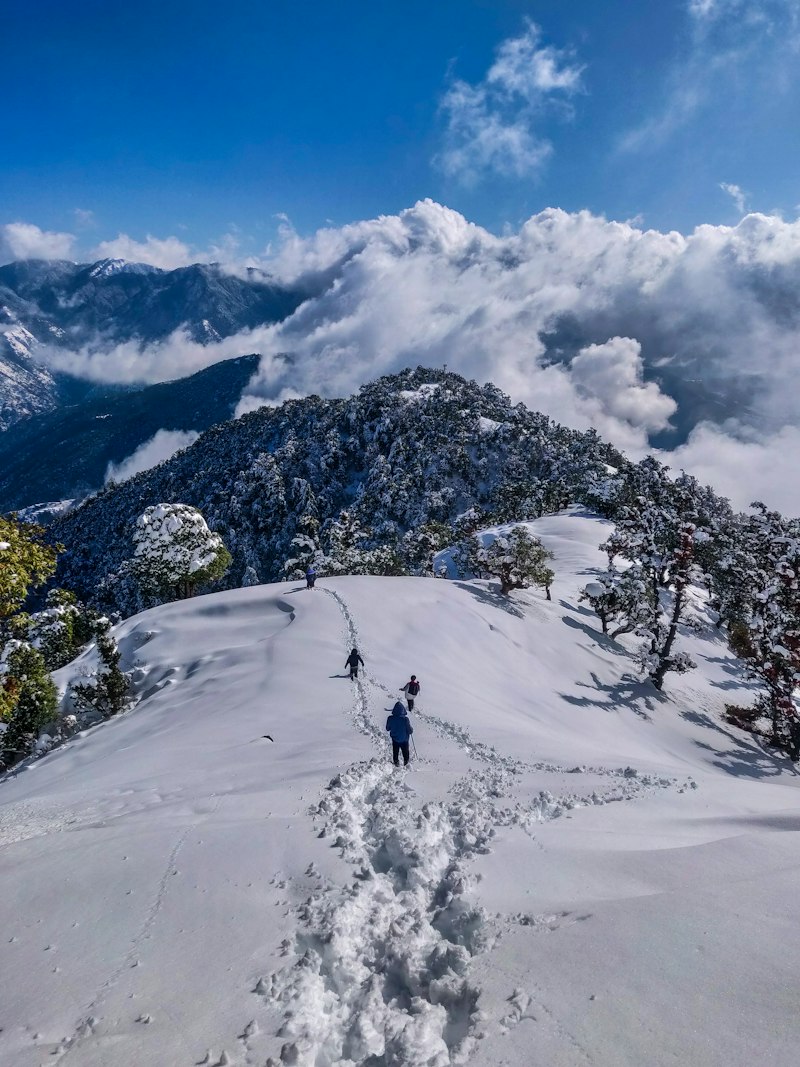
Picking up a 550lb bike in thin air at 16,000 ft is exhausting. Ground clearance matters less than sheer manageability.
Indian village roads and landslide cliff-edges are not built for wide-bodied liter-bikes. The Himalayan cuts through gaps cleanly.
Every village mechanic in the Himalayas can fix a Royal Enfield. A broken electronic sensor on a GS will end your trip.
Ready to straddle the Sherpa?
We reply within 24 hours — usually faster.